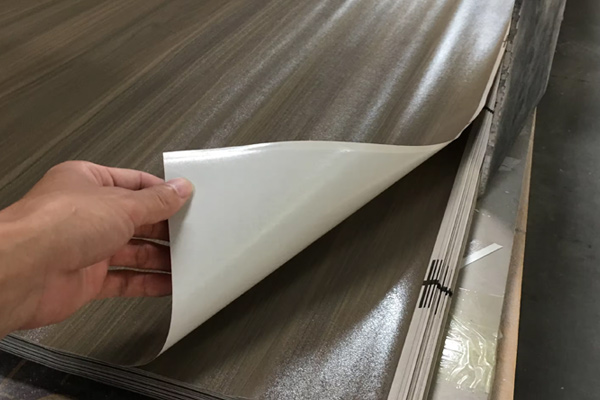
White Alumina wear-resistant powder 6000# for melamine impregnated paper of composite panels
Alumina wear-resistant powder 6000# works well in the wear-resistant layer of melamine-impregnated paper of composite panels. That is a very professional and typical application. White aluminum oxide powder 6000 mesh is far more than increasing hardness and wear resistance in this application. Its core value is to achieve efficient and uniform wear protection without sacrificing transparency and clarity.
1. Provide efficient wear resistance
– Principle: Melamine resin itself has average hardness and is easily scratched. White corundum hardness is Mohs hardness 9 with alumina content over 99%. That is much higher than normal material such as quartz, metal, ceramics in dust, etc.
– Aluminum oxide 6000mesh (about 2-3 microns): This particle size is very fine. If it is too coarse (such as 1000#), the abrasive particles will protrude from the surface, forming a rough touch and easily scratching the contacted objects . The particle size of 6000# is fine enough to mix dispersed in the resin. It continues to provide micro-cutting during the wear process, “sharing” the wear on countless tiny hard particles. Thus it greatly improves the wear resistance level.
2. Maintain high transparency and clarity
– Problem: Coarse-grained alumina powder will seriously scatter light, making the impregnated paper white and turbid, covering the pattern and color of the underlying decorative paper.
– Advantages of alumina 6000 mesh: When the particle size of alumina is smaller than the wavelength of visible light (about 0.4-0.7 microns), its scattering effect is significantly weakened. Although 6000# (2-3 microns) is slightly larger than the wavelength, it is small enough. Compared with 1000# (about 15 microns), its damage to transparency is greatly reduced. White aluminum oxide powder can better match the refractive index of the resin and achieve a high-transparency wear-resistant layer, allowing you to see clear and beautiful decorative paper while getting hard protection.
3. Optimize surface gloss and flatness
– Avoid orange peel: Coarse particles can cause uneven surfaces, creating an “orange peel” or “foggy” sheen (low and uneven gloss). The white corundum 6000# particles are very fine and can form a smooth resin surface. Thereby obtaining uniform and controllable gloss (such as matte, semi-gloss or high gloss).
– Improved touch: The fineness of WFA 6000 mesh ensures that the surface of the final board is delicate and smooth to the touch, with no rough or sandpaper feel. That meets the touch requirements of high-end boards.
4. Improve processing performance and distribution uniformity
– Easy to disperse: Alumina 6000 mesh powder is made by washing with water. In the impregnated resin, the powder is more easily dispersed evenly through high-speed stirring, ultrasonic dispersion, etc. to avoid agglomeration into large particles.
– Reduce web blocking: During the impregnation process, the paper passes through rollers and is coated with resin. The fine powder is not easy to block the filter system of the coating roller or dipping tank, ensuring continuous operation of the production line.
– Reduced settling: Finer particles settle more slowly in liquid resin, helping to maintain a uniform wear layer concentration during the production process and in the final product.
5. Synergy with other materials
– With melamine resin: After curing, the hardness of melamine resin is acceptable, but it is highly brittle. The addition of 6000 mesh alumina can slightly improve its brittleness, making the plate less likely to chip due to local impact.
– Combination with decorative paper: The wear-resistant layer is located on the outermost layer of the decorative paper. The fineness of 6000# allows it to smoothly penetrate into the fiber pores of the decorative paper to form a mechanical lock instead of floating on the surface. Thus enhancing the inter-layer bonding force and avoiding delamination.