
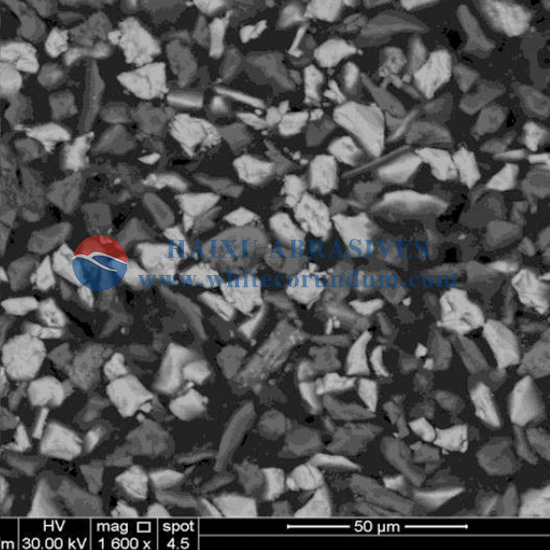


Zirconia Alumina Optical Emery lapping powder 1200#
Zirconia Alumina Optical Emery lapping powder 1200# is an alumina-zirconia composite optical emery powder that combines the self-sharpening properties of alumina with the toughness of zirconia. The combination of silicon dioxide and zirconia can get a moderate hardness. That ensures Optical emery powder does not cause surface damage to wafers or crystals. It is suitable for the grinding and polishing of semiconductor materials—such as gallium arsenide, gallium phosphide, and silicon wafers—as well as optical lenses and optical glass.
Chemical Composition:
| Chemical | Standard Value | Typical Value |
| Al2O3 | 40-57% | 49.8% |
| ZrO2 | 28-33% | 31.2% |
| SiO2 | 11-25% | 15.92% |
| TiO2 | 0.8-2.0% | 1.25% |
| Fe2O3 | <0.1% | 0.05% |
Physical Properties:
| Color | Light brown |
| Specific gravity | ≥3.9g/cm3, Typical value:4.1-4.3g/cm3 |
| Hardnes | 9.0 |
Specifications:
| Grit Size | D0(Micron) | D3(Micron) | D50(Micron) | D94(Micron) |
| #800 | ≤ 33.3 | ≤ 27.5 | 12.0±1.0 | ≥ 7.0 |
| #1000 | ≤ 21 | ≤ 14.7 | 10.3±0.3 | ≥ 7.0 |
| #1200 | ≤ 18 | ≤ 11.8 | 7.2±0.3 | ≥ 4.2 |
| #1500 | ≤ 14 | ≤ 10.0 | 5.8±0.5 | ≥ 3.5 |
| #2000 | ≤ 13 | ≤ 9.0 | 4.7±0.5 | ≥ 2.6 |
| #3000 | ≤ 10.0 | ≤ 6.3 | 3.7±0.4 | ≥ 1.7 |
Product Application:
1) Electronics Industry: Grinding and polishing of semiconductor single-crystal silicon wafers, piezoelectric quartz crystals, and compound semiconductors (such as gallium arsenide and indium phosphide).
2) Glass Industry: Grinding and polishing of optical glass crystals.
FAQ
Q1: Is your alternative to the “FO” polishing powder made of the same material as the original Fujimi FO lapping powder?
It is an alternative material of the same type and for the same application. Both are aluminum oxide-based (zirconia-toughened alumina) precision polishing powders, designed for grinding and polishing semiconductor wafers, optical glass, lenses, and prisms. Like the original product, our powder features a narrow particle size distribution (PSD) and controlled particle shape. The primary differences lie in the specific formulation adjustments for each production batch and the manufacturing location; however, the PSD standards and polishing performance are aligned with the original.
Q2: Does the particle size match the original product? Will customers need to readjust their processes when switching?
Our standard grades are controlled according to the original manufacturer’s PSD specifications, allowing for direct integration into existing processes. Specifically, the D50 (median particle size) is essentially identical, while the D0 (minimum size) and D94 (upper-end size) are more tightly constrained.
We recommend that customers conduct a small-scale trial run when first switching: maintain the existing parameters for slurry concentration, polishing pressure, and platen speed, then fine-tune these by ±5–10% based on the actual material removal rate.
Q3: What are the most common issues when switching to an alternative product, and how can they be avoided?
The most frequent issues are scratches and fluctuations in the material removal rate. These typically stem from two sources: poor control of the particle size distribution at the extremes (D0 and D94), or high levels of iron impurities.
To address this, we strictly control the D0 (maximum particle size) to minimize scratches caused by oversized particles, and we keep Fe₂O₃ content at ≤0.5% to prevent iron contamination. Every batch undergoes rigorous particle size testing before shipment. If customers also implement slurry filtration and ensure that no foreign matter is introduced via circulation pumps, the risk of scratching can be reduced to a level comparable to that of the original product.
Q4: Why is a zirconia-toughened alumina composite used for “FO” applications instead of pure white fused alumina?
ZrO₂ (zirconia) serves to toughen the particles and promote “self-sharpening.” Under mechanical stress, the abrasive grains undergo micro-fracturing, which continuously exposes fresh, sharp cutting edges. This ensures a stable cutting force while preventing the formation of deep, sharp scratches. Pure corundum is highly hard but also quite brittle and prone to dulling; this leads to a rapid drop in material removal rates during the later stages of grinding, as well as poor surface uniformity. This is precisely why FO (fused corundum/abrasive) is well-suited for both silicon wafer grinding and the polishing of optical components.
Q5: What types of workpieces can it be used on? What grit sizes are recommended?
– Semiconductor silicon wafers and compound semiconductor wafers: #800 to #1200 (for rough to fine grinding)
– Optical glass, lenses, prisms, and filters: #1200 to #2000
– Sapphire, crystals, and hard disk substrates: #2000 to #3000
– Mirror-finish pre-processing for high-value-added components, such as metals and cemented carbides: #1500 to #3000
Q6: How does it compare to the original manufacturer’s product in terms of price, minimum order quantity (MOQ), and lead time?
Produced locally—eliminating import tariffs and long ocean freight transit times—our product is generally priced lower than the original manufacturer’s equivalent. Grit sizes from #800 to #3000 are kept in stock. Standard packaging options include 5 kg bags, or 10 kg/20 kg paper bags; bulk supply and custom small-package options are also available. Samples can be prepared in 2–3 days, and the lead time for bulk orders is 7–15 days.
